


When you look at pricing pages for in-app guidance software, you notice an annoying pattern: almost nobody publishes actual numbers.
Instead, you get "Schedule a Demo," "Talk to Sales," or calculator widgets that capture your email before telling you nothing.
The industry hides its pricing because software license fees are only a fraction of what buyers actually end up paying. Between monthly active user (MAU) penalties, mandatory implementation packages, and hours your engineers waste fixing brittle CSS selectors whenever your interface changes, digital adoption tools often cost three to five times their contract sticker price.
This breakdown covers what vendors charge in 2026, where the hidden bills hide, and how to set up effective in-app guidance without burning your software budget.
Quick summary: What does in-app guidance cost in 2026?
Depending on your user base and technical architecture, expect the following ranges:
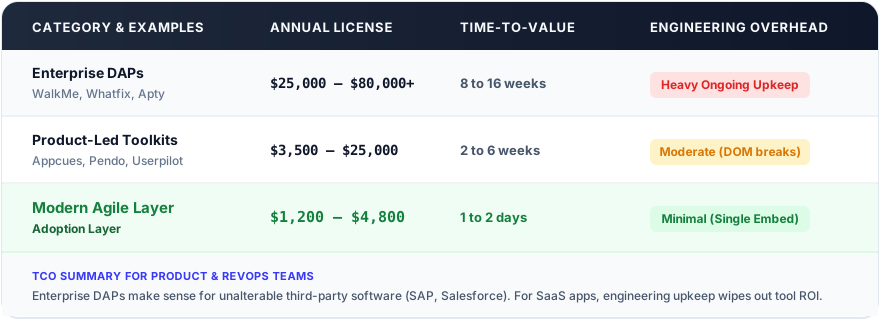
- Enterprise DAPs (WalkMe, Whatfix): $25,000 to $80,000+ per year. These require multi-year commitments, professional onboarding packages ($3,000 to $10,000), and custom quoting.
- Product-Led Toolkits (Appcues, Pendo, Userpilot): $3,500 to $25,000 per year. Pricing tracks your monthly active users (MAUs), which means your bill jumps as your product grows.
- Modern Agile Layers (Adoption Layer): $1,200 to $4,800 per year ($99 to $399/month). Simple flat rates or clear event tiers, zero engineering overhead, and self-serve deployment.
| Platform Category | Leading Examples | Annual Software License | Real Time-to-Value | Ongoing Engineering Maintenance | Best Suited For |
|---|---|---|---|---|---|
| Enterprise DAP | WalkMe, Whatfix, Apty | $25,000 – $80,000+ | 8 to 16 weeks | High (dedicated full-time specialists or agencies) | Legacy internal systems (SAP, Workday, Salesforce) |
| Product-Led Onboarding | Appcues, Pendo, Userpilot | $3,500 – $25,000 | 2 to 6 weeks | Moderate (fixing CSS selectors after UI releases) | Mid-market SaaS customer onboarding with dedicated product teams |
| Modern Agile Layer | Adoption Layer | $1,200 – $4,800 | 1 to 2 days | Minimal (single isolated embed, zero DOM drift) | SaaS scale-ups, RevOps, and fast-shipping product teams |
How in-app guidance vendors price their software
Software companies in this space use two main pricing levers: user volume (MAUs or employee seats) and feature gates. Understanding how these levers work helps you avoid surprises when your contract comes up for renewal.
1. The MAU trap (Product-Led tools)
Platforms built for SaaS customer onboarding (such as Appcues or Pendo) charge by Monthly Active Users.
At first glance, a $250/month entry tier looks reasonable. The catch is what happens when your user base expands:
- Entry tier: 1,000 to 2,500 MAUs. You pay roughly $3,000 to $5,000 per year for basic tours and tooltips.
- Mid-growth tier: 10,000 to 25,000 MAUs. Pricing jumps to $12,000 to $22,000 per year.
- Scale tier: 50,000+ MAUs. You are pushed into custom quotes that routinely cross $35,000 annually.
According to verified contract data compiled by Vendr's software marketplace, the median contract for Pendo lands at $48,500 per year, with large deployments climbing well past $100,000.
The problem with MAU billing is that it penalizes your success. If your marketing team runs a successful campaign or you offer a free plan, your active user count spikes. You end up paying full MAU rates for inactive users who logged in once, looked around, and never came back.
2. The seat-based enterprise model (Enterprise DAPs)
Enterprise vendors like WalkMe primarily target internal software adoption (guiding employees through Workday, Salesforce, or SAP). Their pricing scales by employee seats and the number of applications you instrument.
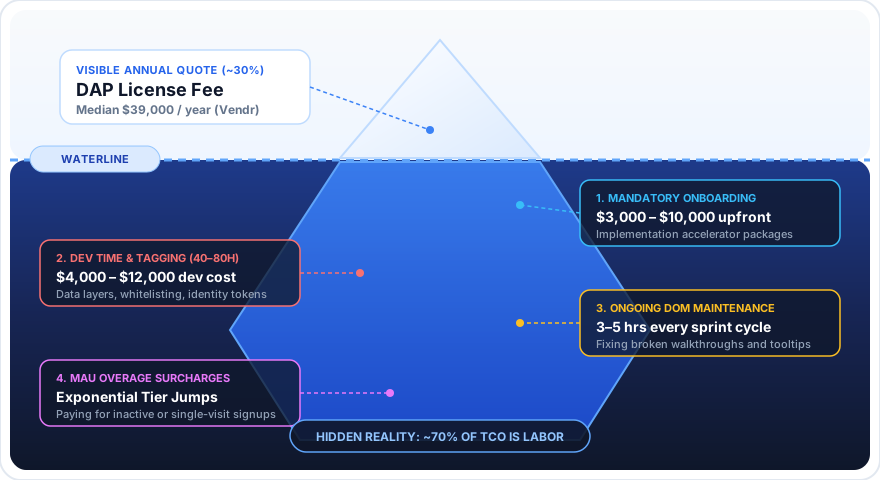
Based on benchmark data analyzed across verified customer transactions by Userpilot's WalkMe pricing report, the median annual cost for WalkMe sits around $39,000 per year, with custom implementations ranging from $14,400 to over $190,000.
Enterprise vendors also bundle annual contract commitments with mandatory upfront services. If you try to negotiate a monthly agreement or cancel after six months, you will hit a wall.
The 4 hidden costs of digital adoption platforms
Software licenses are only the visible tip of the expense. The real budget drain happens after you sign the contract.
1. The engineering setup tax
Sales reps love promising "no-code deployment." What they mean is that non-technical team members can drag and drop tooltips after developers configure your application.
In reality, legacy platforms require engineering teams to install complex scripts, configure custom data layers, whitelist analytics endpoints, and map user identity tokens. A typical mid-market rollout consumes 40 to 80 developer hours. At standard software engineering rates ($100 to $150/hr), you spend $4,000 to $12,000 in internal developer time before launching your first walkthrough.
2. Maintenance overhead and broken selectors
This is where traditional DAP projects quietly die. Traditional in-app guides attach to your product interface using CSS selectors or DOM paths.
When your frontend team ships a routine UI update, refactors a component in React or Vue, or tweaks an element ID, the selector breaks. The tooltip either detaches, floats in the middle of empty space, or disappears completely.
Someone has to notice the bug, file a ticket, log into the DAP builder, re-anchor the guide, and test it again. Teams frequently spend 3 to 5 engineering hours every sprint just fixing broken walkthroughs. Over a year, that ongoing maintenance costs more than the original software license.
3. Mandatory onboarding packages
Many enterprise vendors refuse to activate your subscription unless you purchase their "Professional Services" or "Implementation Accelerator." These packages range from $3,000 for standard setup to $15,000 for guided enterprise onboarding.
Vendors justify this because their authoring studios are so complex that an untrained user cannot build reliable guides without weeks of certification training.
4. Application performance and script weight
Digital adoption platforms inject third-party JavaScript into your production app. Heavy scripts can degrade performance, increase page load times, and drag down your Core Web Vitals.
When an onboarding script adds 250kb of vendor code to your initial bundle, it directly hurts user conversion and customer experience.
How to implement in-app guidance without breaking the bank
If you run a product team, a scale-up, or an operations department, you probably do not need an enterprise platform built for Fortune 500 HR departments. You need a practical way to answer user questions, highlight new features, and unblock workflows.
Here is how to get effective in-app guidance running on a reasonable budget:
1. Ditch fragile DOM tours for contextual assistance
Stop building 12-step product tours that take over the screen. Data from hundreds of SaaS onboarding studies shows that over 70% of users dismiss multi-step tours on the first or second step.
Instead of forced tours, place contextual guidance directly where users hesitate. Small, intelligent cues that trigger when an action fails or when someone pauses on a complex screen provide immediate value without annoying your users.
2. Demand a lightweight embed
Look for solutions that load via a single, isolated script tag. The widget should run inside an error boundary so that even if a guidance script encounters an unexpected issue, your core web application never crashes.
3. Avoid MAU penalties
Pick tools with predictable pricing tiers based on features or actual guidance interactions, not total registered or active users. You should never receive a surprise $4,000 overage invoice just because a blog post went viral and drove a wave of casual visitors.
4. Verify self-service deployment
If a vendor requires a sales call before giving you access to a sandbox or test environment, assume their software is too complicated for you to run alone. The best modern tools let you install a snippet, configure your first guidance flow in a staging environment, and see results within an afternoon.
How Adoption Layer compares
We built Adoption Layer specifically to solve the frustration of enterprise bloat and opaque pricing.
- Transparent pricing: Predictable plans starting at simple monthly rates, without surprise MAU penalties or mandatory five-figure onboarding fees.
- Zero engineering maintenance: Our lightweight vanilla JavaScript widget attaches cleanly to your application without fragile CSS selectors that break during product sprints.
- Native error containment: An isolated runtime ensures your core application performance and security are never compromised.
- Instant time-to-value: You can drop the embed into your application, test your first guidance journey, and go live in minutes, not months.
Frequently asked questions about in-app guidance costs
What is the average price range for in-app guidance software in 2026?
Expect to pay between $1,200 and $5,000 per year for modern, lightweight guidance tools. Mid-market product onboarding platforms range from $5,000 to $25,000 per year depending on MAU volume. Enterprise platforms like WalkMe and Whatfix typically start around $25,000 to $40,000 per year and can exceed $100,000 for large multi-app deployments.
Can I implement in-app guidance without engineers?
Yes, but with caveats. Most tools let non-technical team members draft guides, but older platforms still require engineers to install custom tracking tags and continuously fix broken elements. Modern solutions like Adoption Layer reduce engineering work to a single script embed, after which product and operations teams can manage guidance independently.
Why do digital adoption platforms cost so much?
Enterprise vendors price their tools based on high-touch consulting models. They factor in sales commissions, mandatory customer success reps, and custom integration engineers. In contrast, modern developer-friendly tools eliminate that overhead by offering clean software that works out of the box.