

The vendor demo is always slick.
A sales engineer from WalkMe, Whatfix, or Apty opens a test account, fires up their browser extension, clicks on a form, and types a prompt. A bright tooltip anchors to the screen: "Click here to qualify a lead."
Everything works. The quote lands in your inbox a week later: $35,000 a year. You run it through procurement, get it signed, and figure your onboarding headache is handled.
A year later, you pull the actual numbers. You did not spend $35,000. You spent closer to $140,000.
The vendor did not overcharge on the software. What they left out of the quote was the second invoice. The one paid in full time salaries, builder certifications, and endless sprint cycles spent fixing guides that stopped working after a Salesforce patch.
The license fee is just the down payment. The bulk of the money goes toward propping up an architecture that was never designed for modern web applications.
How much do enterprise digital adoption platforms actually cost?
Enterprise digital adoption platform licenses median between $30,000 and $45,000 a year for a single application, though multi-tool enterprise rollouts frequently exceed $150,000 to $400,000. None of the major vendors publish these numbers publicly; prospective buyers must sit through qualification calls before receiving a proposal.
Procurement data compiled from real buyer contracts by platforms like Vendr reveals what organizations actually pay:
- WalkMe: Vendr transaction data via Supered shows a median contract value of $39,000 a year across 45 analyzed deals. Pricing spans from $14,400 on small setups to $197,118 on large deployments. Enterprise rollouts covering four or five business tools regularly push past $400,000.
- Whatfix: Userpilot's contract analysis benchmarks Whatfix at a median annual contract of $31,950, with most single-tool deals clustering between $26,210 and $37,914.
- Apty: The Vendr Apty buyer guide records an average contract value of $44,666, with transactions ranging from $26,000 to $78,000.
- Userlane: The Vendr Userlane buyer guide logs an average contract value of $17,529, with contracts reaching $25,000 for broader scopes.
- Lemon Learning: The Lemon Learning pricing model quotes per application or across the full company, and always scopes implementation as a separate, paid line item.
On paper, thirty or forty grand a year sounds reasonable for an enterprise wanting to train employees on an ERP.
The trouble starts right after the contract is signed.
What are the hidden costs behind a digital adoption quote?
A digital adoption quote covers access to the software editor, but omits the three largest expense categories required to run it: professional services, builder certification, and internal headcount.
Implementation fees
You cannot hand a tool like WalkMe to an HR manager on a Monday and expect live tours by Friday. It requires technical configuration.
Procurement analyses from CostBench's WalkMe hidden costs report indicate that setup services add 20% to 30% to the first year contract value, roughly $10,000 to $35,000. On complex rollouts, vendor statements of work regularly reach $50,000 to $100,000 just to map the initial paths.
Builder certification
Because building guides requires an understanding of CSS hierarchy, vendors sell specialized training. Certifying internal builders through courses like the WalkMe Institute costs anywhere from $5,000 to $25,000 depending on seat count.
The dedicated builder salary
This is where the real money goes.
Salary data from Talent.com's Digital Adoption Specialist benchmark across 10,000 listings shows an average base salary of $76,193 a year in the United States, with senior builders making over $140,000. Once you include taxes, benefits, and equipment, that employee costs an organization roughly $100,000 to $120,000 a year.
In Europe, Talent.com France reports an average base of 41,000 euros for a change management project lead, which translates to 60,000 to 75,000 euros in total employer cost.
Even if you do not hire someone full time and instead pull half the time of an existing product manager or operations lead, you are tying up $50,000 in internal labor just to babysit walkthroughs.
What does Forrester's economic research reveal about maintenance?
In WalkMe's commissioned Forrester Total Economic Impact study, ongoing content maintenance exceeded initial implementation costs, logging $387,384 in routine upkeep over three years compared to $350,182 for initial rollout.
The report was designed to highlight the financial returns of the software, so its assumptions were intentionally optimistic. Even so, on pages 20 through 23 of the official Forrester WalkMe TEI report, Forrester documented the exact operational drag:
- Implementation required $350,182 over three years for a composite enterprise, including $105,000 paid to WalkMe for professional services and $245,000 in internal staff hours.
- Routine maintenance cost $387,384 over the same three-year window.
- For every single application covered, one product manager had to spend two full months every year just maintaining WalkMe content, plus an extra 4 to 10 days of vendor professional services at $800 a day.
When an editor's own commissioned ROI study admits that ongoing upkeep costs more than initial setup, maintenance is not an edge case. It is the operating model.
Why do digital adoption walkthroughs and CSS selectors constantly break?
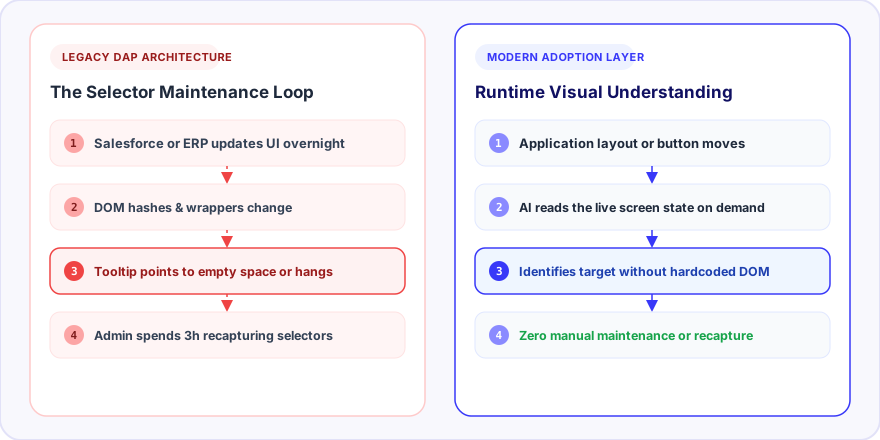
Walkthroughs break because traditional DAPs anchor static CSS selectors and XPaths to dynamic DOM trees that shift with every sprint, third-party software patch, or component rebuild.
A digital adoption platform works by injecting JavaScript into the page. When an author builds a tour, the software inspects the HTML and grabs a CSS selector or XPath:
#main-content > div:nth-child(2) > div.slds-form-element > div > input[type="text"]
That selector is rigid. If anything changes around it, the guide breaks.
Dynamic frameworks
Modern frontends built on React, Vue, or Next.js compile styles into random hashes. A button might have one class name today and a completely different hash next week after an automated build. Component IDs generated at runtime change between sessions.
Salesforce releases
Salesforce ships three major updates every year: Spring, Summer, and Winter. Lightning Web Components use Shadow DOM encapsulation, which isolates internal markup from external scripts. When Salesforce updates an internal wrapper or reorganizes the Lightning Design System, outside scripts lose track of the elements.
Third-party software updates
If you put a guide on top of Workday, HubSpot, or SAP, you have no say in when those platforms update their interface. The vendor pushes an update overnight, and by 9 AM your onboarding flow is pointing at empty white space.
WalkMe's official troubleshooting documentation says this directly:
"If you're modifying the default item settings and switch it from Automatic to Identify by text or jQuery selector, pay attention to the context as it takes the smallest change to break the configuration due to its hardcoded nature... Even a minor modification to the page structure breaks the flow."
Vendors know this is a structural flaw. WalkMe bought DeepUI to help algorithms guess when an element moves. Whatfix sells an automated flow testing feature in its high tier plans to alert admins when tours break.
According to Gartner's 2025 Market Guide for DAPs, digital friction reduces worker productivity by 9% to 12% precisely because employees struggle with fragmented, constantly shifting application interfaces. But an automated alert that a guide has broken does not fix the friction. A human still has to log into the studio, recapture the screen, and republish the guide.
What is the real completion rate of multi-step product tours?
Multi-step walkthroughs experience an 84% drop-off rate, with completion plunging from 72% on three-step tours to just 16% on seven-step flows according to industry benchmarks. While internal teams spend dozens of hours fixing selectors, employees are actively closing the guides.
Data from Chameleon's 2025 product tour benchmarks highlights the steep drop:
- A 3-step tour completes around 72% of the time.
- A 7-step tour completes only 16% of the time.
That means 84% of users drop out or hit the close button before step seven. Furthermore, Chameleon found that unprompted popups get dismissed two to three times more often than help requested by the user.
You end up paying six figures a year to maintain multi-step tutorials that most employees close within three seconds.
How do you calculate the true 3-year TCO of a DAP?
To calculate the true 3-year Total Cost of Ownership of a DAP, you must combine the subscription license with professional onboarding services, builder training, and dedicated internal maintenance salaries.
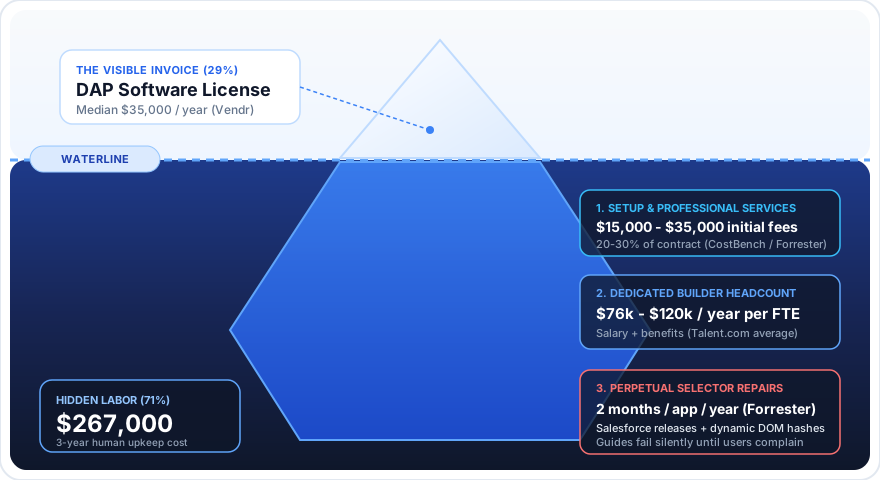
Here is a realistic breakdown for a mid-market company running a DAP on two enterprise tools:
| Expense Category | Year 1 | Year 2 | Year 3 | 3-Year Total | Share of Total |
|---|---|---|---|---|---|
| Software License | $35,000 | $37,450 | $40,000 | $112,450 | 29.6% |
| Setup and Services | $15,000 | $5,000 | $5,000 | $25,000 | 6.6% |
| Training and Certifications | $5,000 | $0 | $0 | $5,000 | 1.3% |
| Internal Headcount (0.8 FTE) | $76,000 | $79,000 | $82,000 | $237,000 | 62.5% |
| Total Annual Cost | $131,000 | $121,450 | $127,000 | $379,450 | 100% |
Across three years, the license makes up less than a third of the total spend. More than 70% goes straight to the human labor required to build, test, and repair broken selectors.
How can teams guide enterprise users without hardcoded DOM selectors?
Digital adoption platforms were built in the early 2010s, when web pages were mostly static HTML and release cycles happened twice a year. Tying a coordinate to a CSS selector worked well enough back then.
On modern software, relying on hardcoded DOM paths is like building on quicksand.
There are better ways to approach this:
- Pull instead of push. Stop interrupting employees with unprompted popups while they are trying to do their jobs. Provide guidance when they ask for help or when they get stuck.
- Visual understanding over CSS paths. Modern vision models can look at a live screen the way a human does, recognizing inputs and buttons without needing a brittle DOM selector.
- Adaptive guidance. When the system understands what is on the screen in real time, application redesigns do not break your training materials.
If you are evaluating adoption platforms, do not stop at the subscription price. Ask the vendor how many hours a week their existing customers spend updating broken elements, and make sure you budget for the people who will have to keep them alive.